Welcome to
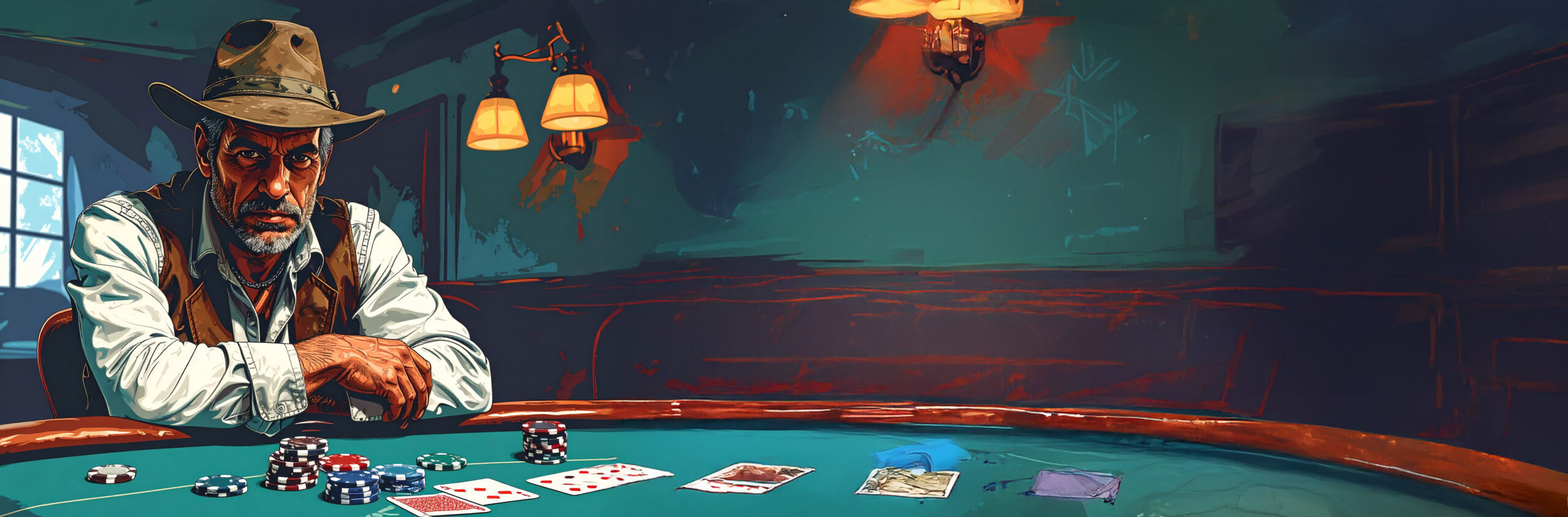
Gambling George Rose
The Legend
Chapter 1: Jersey Beginnings
George Rose learned about odds before he learned to tie his shoes. Growing up in the grimy tenements of Camden, New Jersey, in the late 1940s, he watched his father lose their grocery money to neighborhood card sharks every Friday night. While other kids played stickball in the streets, George studied those games from the shadows, his sharp ten-year-old mind cataloging every tell, every pattern, every mathematical probability that the adults missed.
His mother, Margaret, worked double shifts at the textile mill, her fingers permanently stained with indigo dye. She never knew about the small bills George would slip into her purse—winnings from penny-ante games with older kids who thought they could outsmart the scrawny boy with the calculating eyes.
“Mathematics is just another language, Georgie,” his teacher Mrs. Patterson told him after he solved a complex probability problem in his head. “And you speak it like a native.”
By age sixteen, George had memorized every card counting system he could get his hands on, practiced basic strategy until it was muscle memory, and bankrolled his first real stake: $127 earned from weekend construction work and carefully managed poker games in the school basement.
Chapter 2: The Road West
The summer of 1955 found George behind the wheel of a beat-up ’49 Mercury, heading west with nothing but his stake money, a dog-eared copy of “Beat the Dealer,” and an unshakeable belief that Las Vegas was calling his name. He was eighteen, tall and lean, with dark hair that perpetually fell across his forehead and eyes that seemed to calculate the odds on everything from which lane of traffic moved fastest to whether it would rain.
In Chicago, he stopped for three days and turned his $127 into $340 playing in illegal backroom games near the stockyards. In Kansas City, he worked as a short-order cook for two weeks, saving every penny while perfecting his card skills with the night-shift waitresses. In Denver, he met Maria Santos, a young woman whose car had broken down on the side of Highway 6.
“I can fix that,” George said, rolling up his sleeves. He’d learned basic mechanics from his neighbor Mr. Kowalski back in Camden—not because he loved cars, but because he understood that every skill was a potential edge.
Three hours later, Maria’s Chevy was purring like new. She tried to pay him, but George waved her off. “Just doing what’s right,” he said. What he didn’t mention was that helping her had made him feel something he’d rarely experienced: genuine satisfaction that had nothing to do with odds or winnings.
“Where you headed?” Maria asked.
“Las Vegas”
She laughed, “Be careful out there, Gambling George, The house always wins, you know.”
It was the first time anyone had called him that, and somehow the nickname stuck.
Chapter 3: Neon Nights
Las Vegas in 1955 was a fever dream of possibility. The Flamingo’s pink neon cast everything in an otherworldly glow, the Sands attracted Hollywood royalty, and the Desert Inn was where serious players came to prove themselves. George checked into a modest motel off the Strip and spent his first week simply observing.
He watched the dealers, studied their rhythms, noted which pit bosses were sharp and which were lazy. He observed the players—the tourists who bet with their hearts, the locals who knew the games but lacked discipline, and the occasional professional who moved through the casinos like a shark through calm waters.
His first real play was at a $5 blackjack table at the Golden Nugget. George bought in for $50 and played perfect basic strategy, varying his bets according to his count. Six hours later, he walked away with $178, having impressed the dealer with his quiet competence and mathematical precision.
“You’ve got the touch, kid,” said an older player named Sal Benedetto, who’d been watching from across the pit. “But you’re playing too small. The real money’s in the high-limit rooms.”
Sal became George’s unofficial mentor, teaching him not just about cards but about the ecosystem of Las Vegas—which casinos welcomed skilled players, which ones would back off counters immediately, and how to manage heat from surveillance.
Chapter 4: The Grind
By day, George worked construction on the Strip’s newest hotels, helping to build the very casinos where he’d play at night. His hands grew calloused from handling rebar and cement, but his mind stayed sharp, always calculating. He’d arrive at job sites before dawn, work until late afternoon, grab a quick dinner, and then hit the tables until 2 AM.
The construction work served multiple purposes: it provided legitimate income to supplement his gambling bankroll, it gave him cover as a regular working guy rather than a professional gambler, and it satisfied something in his character that needed to build rather than just take.
One scorching July afternoon, George noticed that Tommy Martinelli, a fellow construction worker, hadn’t shown up for the third day in a row. After work, he drove to Tommy’s apartment and found the man’s wife, Angela, crying at the kitchen table while two young children played quietly in the corner.
“Tommy’s been drinking again,” she said. “Lost his last paycheck at the slots. I don’t know how we’re going to make rent.”
George reached into his wallet and counted out $200. “This is from Tommy’s crew,” he said gently. “We look out for each other.”
It wasn’t exactly true, but it wasn’t exactly false either. George made sure to have a word with Tommy when he returned to work, and somehow, without being preachy or threatening, conveyed that there were people depending on him who deserved better.
Chapter 5: Speed and Steel
Las Vegas weekends in the late ’50s weren’t just about gambling. On Saturday nights, the real action moved to the outskirts of town, where guys with fast cars and steady nerves tested themselves on improvised drag strips carved out of the desert.
George had traded his Mercury for a 1957 Chevy Bel Air, cherry red with a modified V8 that he’d built himself in the spare garage behind his apartment. Racing wasn’t gambling—it was pure skill and nerve—but it attracted the same kind of people who understood risk and reward.
“You sure about this, Jersey?” called out Ricky Torrino, a local favorite whose black Oldsmobile 88 had never lost a race. “This ain’t cards. Can’t count your way out of trouble at 90 miles per hour.”
George just smiled and slipped on his driving gloves—the same ones he wore at the blackjack tables. They were lucky, and George Rose believed in making his own luck.
The quarter-mile race was over in 14.3 seconds. George’s Chevy crossed the finish line a full car length ahead of Ricky’s Oldsmobile, and the crowd of gamblers, showgirls, and general hell-raisers erupted in cheers. More importantly, George had won $500 in side bets—all carefully calculated based on his knowledge of his car’s capabilities versus the competition.
“How’d you know you’d win?” asked Betty Morrison, a cocktail waitress from the Sahara who’d bet on George against the local favorite.
“Same way I know when to hit on sixteen,” George replied. “You study the variables, calculate the odds, and trust your preparation.”
Chapter 6: The Big Score
By 1961, George had established himself as one of the Strip’s most respected regulars. He wasn’t flashy—no gold chains or pinky rings—but the pit bosses knew him as a player who always paid his markers, never caused trouble, and possessed an almost supernatural ability to read the flow of cards.
His bankroll had grown to nearly $50,000, enough to take a shot at the high-limit games where the real money was made. The invitation came from Anthony “Tony” Romano, who ran private games for serious players in a suite at the Dunes.
“George, you’ve been grinding long enough,” Tony said over dinner at the Flame Restaurant. “Time to see if you can swim with the sharks.”
The game was $100 minimum bet blackjack, with a $10,000 maximum. The other players included a cattle rancher from Texas, a Hollywood producer, and two professional gamblers from New York who’d driven cross-country just for this action.
George played for eighteen straight hours, taking breaks only when the cards went cold. He varied his play expertly, betting big when the count was high, laying low when the deck was unfavorable. By dawn, he was up $27,000—enough to change his life completely.
But what impressed the other players wasn’t just his skill; it was his composure. When the Texas rancher went bust chasing a bad streak, George quietly lent him money for gas to get home. When the Hollywood producer complained about his luck, George bought a round of drinks and kept the mood light.
“You’re a class act, Rose,” the producer said as they shook hands at sunrise. “You’ve got the killer instinct at the table, but you’re still human away from it. That’s rare in this business.”
Chapter 7: Giving Back
Success didn’t change George’s essential character. As his reputation grew and his bankroll swelled, he found himself increasingly drawn to helping others who reminded him of his younger self—people who were struggling but hadn’t given up hope.
He began quietly backing promising young dealers, lending them money to attend dealing school and get their gaming licenses. He helped several fellow construction workers start their own contracting businesses. When Maria Santos—the woman whose car he’d fixed years earlier—tracked him down in Las Vegas, he discovered she was a single mother trying to put herself through nursing school.
“I never forgot your kindness,” she told him over coffee at the Horseshoe. “I wanted to thank you properly.”
George not only refused her thanks but quietly arranged for her tuition to be paid “by an anonymous donor.” He never told her it was him, but he made sure to check on her progress until she graduated and became head nurse at Sunrise Hospital.
Chapter 8: The Legend Grows
By the mid-1960s, Gambling George Rose had become a fixture of Las Vegas folklore. Dealers would request to work his games because he tipped well and never blamed them for bad runs. Casino managers respected him because he understood the business—he won consistently but never tried to break the house, and he brought a level of sophistication to their gaming rooms that attracted other high-quality players.
His reputation extended beyond the casinos. On weekends, he could still be found at the drag races, where his rebuilt Chevelle SS was now a serious contender against purpose-built racing machines. He’d opened a small garage specializing in performance modifications, not because he needed the money but because he enjoyed the pure problem-solving challenge of making cars faster.
“George Rose is what Vegas is supposed to be about,” wrote a columnist for the Las Vegas Sun. “Skill, style, and just enough danger to keep things interesting. He’s proof that in this town, if you’re smart enough and tough enough, you can still win on your own terms.”
Epilogue: The House Always Wins, But So Does Character
As the 1960s wound down and Las Vegas began its transformation into a corporate playground, George Rose adapted as he always had. He diversified his interests, investing in real estate and small businesses around the valley. He never married, though he had several long relationships with strong women who understood his life and didn’t try to change it.
The young man from Camden had become a Las Vegas institution, but he never forgot where he came from or what mattered most. Every Christmas, he’d drive back to New Jersey to visit his mother, bringing her stories of the neon city and evidence of the successful life he’d built through intelligence, discipline, and an unshakeable belief that the right combination of skill and character could beat any odds.
“The house always wins,” he’d tell young players who sought his advice. “But that doesn’t mean you can’t win too. You just have to be smart about it, disciplined about it, and remember that the most important bets aren’t always the ones you make at the table.”
In the end, that might have been Gambling George Rose’s greatest edge of all—understanding that while cards and dice and racing engines could make you money, character and compassion were what made you rich.
The legend of Gambling George Rose lived on in Las Vegas long after the man himself faded into the desert sunset, a reminder that in a city built on risk, the safest bet was always on yourself.